Fraud & Risk Detection
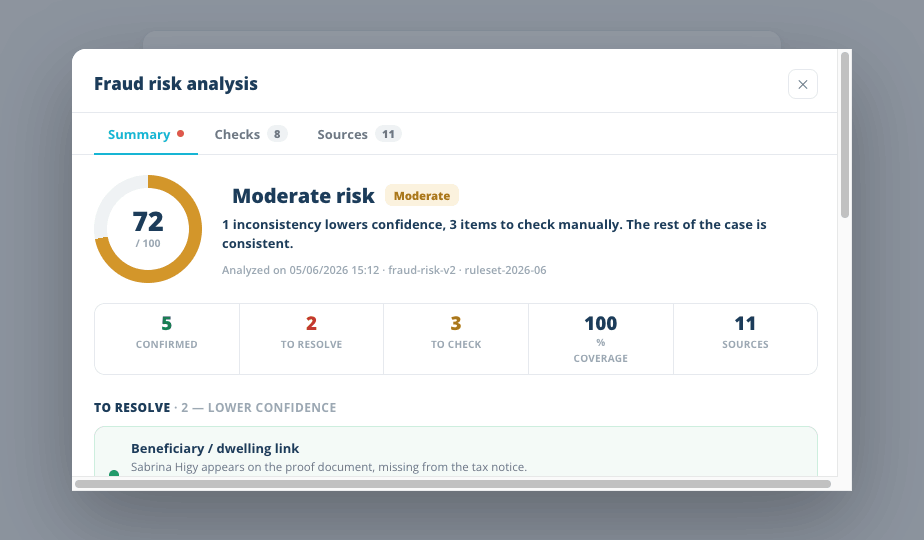
Ceertia cross-checks each file against official external sources and scores its confidence out of 100. Proven inconsistencies lower the score. Points no source could confirm are gray zones to verify, never counted as risks. And every level is sourced, never a black box.
What it checks, in practice.
One rule, as it runs.
Flag any document already used in another of your files, citing both file references as evidence; a missing source is reported as coverage, not as fraud.
Verdict stored with sourced evidenceFrom submission to arbitration.
On submission, checks across five categories — beneficiary, address, building, contractor, consistency — run against official sources.
Proven inconsistencies lower the score. Points no source confirmed are gray zones — never counted as risks. Same case, same rules, same score.
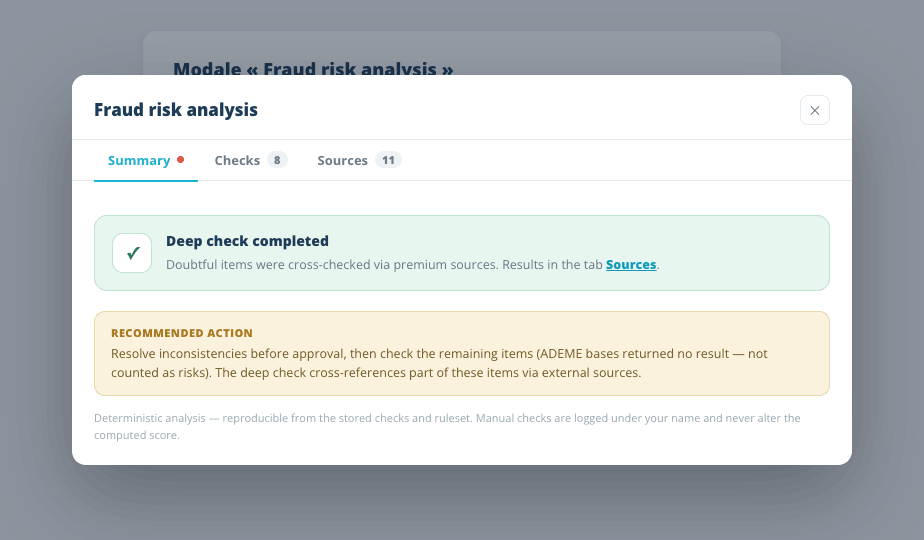
Each item can be cleared manually — logged under your name, never altering the computed score — or automatically via the deepening.
Your team confirms or dismisses the signals. The final decision stays yours — the engine never blocks a file on its own.
A score you can recompute.
- Same file, same rules, same score — every time
- Recomputable and auditable from the stored checks and ruleset
- Proven inconsistencies lower it; unconfirmed points never do
- Manual resolutions annotate the file — they never alter the computed score
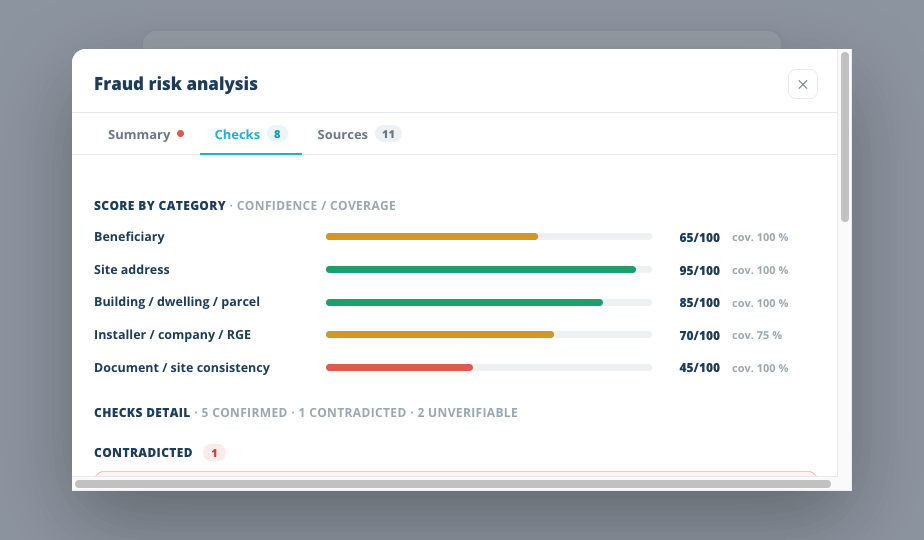
Confidence and coverage, per category.
Illustrative record. Coverage shows how much of the category a source could actually cross-check — a low score points at the exact category to review.
An inconsistency is not a doubt.
Most fraud tools blur them into one score. Ceertia keeps them apart: what is proven wrong lowers confidence; what simply could not be confirmed is a gray zone your team clears — automatically or by hand.
Proven inconsistencies — between documents in the file, or against an official source. Each one lowers the confidence score until it is resolved.
Points no source could confirm — a public registry returned no result. Gray zones, not risks: they never penalize the file the way a contradiction does.
Every check, on the record.
For each check: the data in the file, the source consulted, the result, and its impact on the score. Contradictions surface first.
Illustrative record. The checks — and the sources behind them — depend on your industry and your country.
The real analysis, as your team sees it.
One clear level per file.
No signal. Sources agree.
Minor or incomplete signals, nothing proven.
Serious contradictions between documents and sources.
Major inconsistency. Strong fraud suspicion.
Not enough data to conclude.
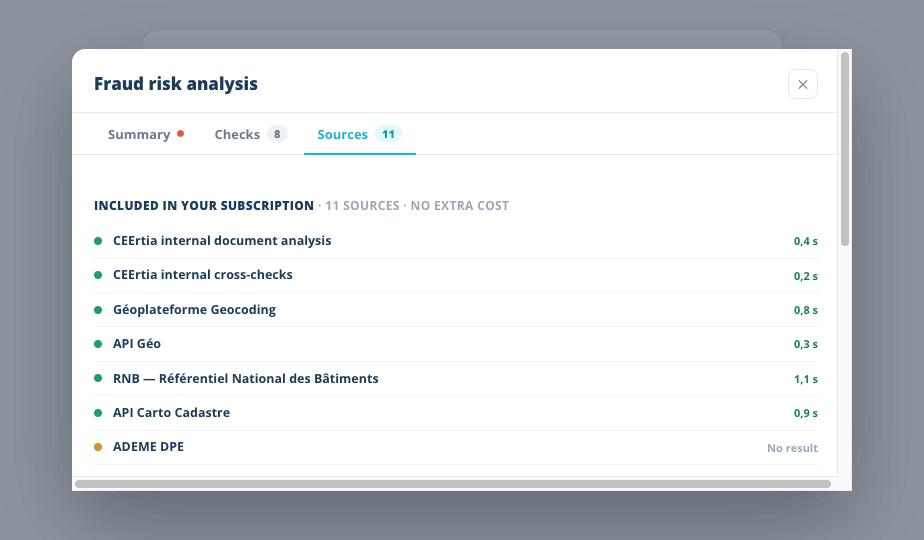
Your source of truth, wherever it lives.
Ceertia connects to the public and premium registries that matter for your files. The fraud engine pulls the data, cross-checks it, and turns each result into a sourced verdict. The right sources depend on your industry and your country, so the connections do too.
A doubt left? Deepening cross-checks it via premium sources and clears the gray zones automatically. Confirmed before purchase, billed once per file.
The engine flags. Your team decides.
Same file, same rules, same score. Recomputable at any time from the stored checks and ruleset.
Manual lifts are recorded by name and timestamp, reversible — and they never alter the computed score.
The level sets processing priority — Ceertia never blocks a file on its own. How oversight works →
It runs on the same evidence-based core as the rest of the engine. Standardized use cases carry a 90% quality floor. Miss it, and the file is not billed.
See it run on your files.
Bring a real file to a 30-minute demo. See the evidence behind every verdict.